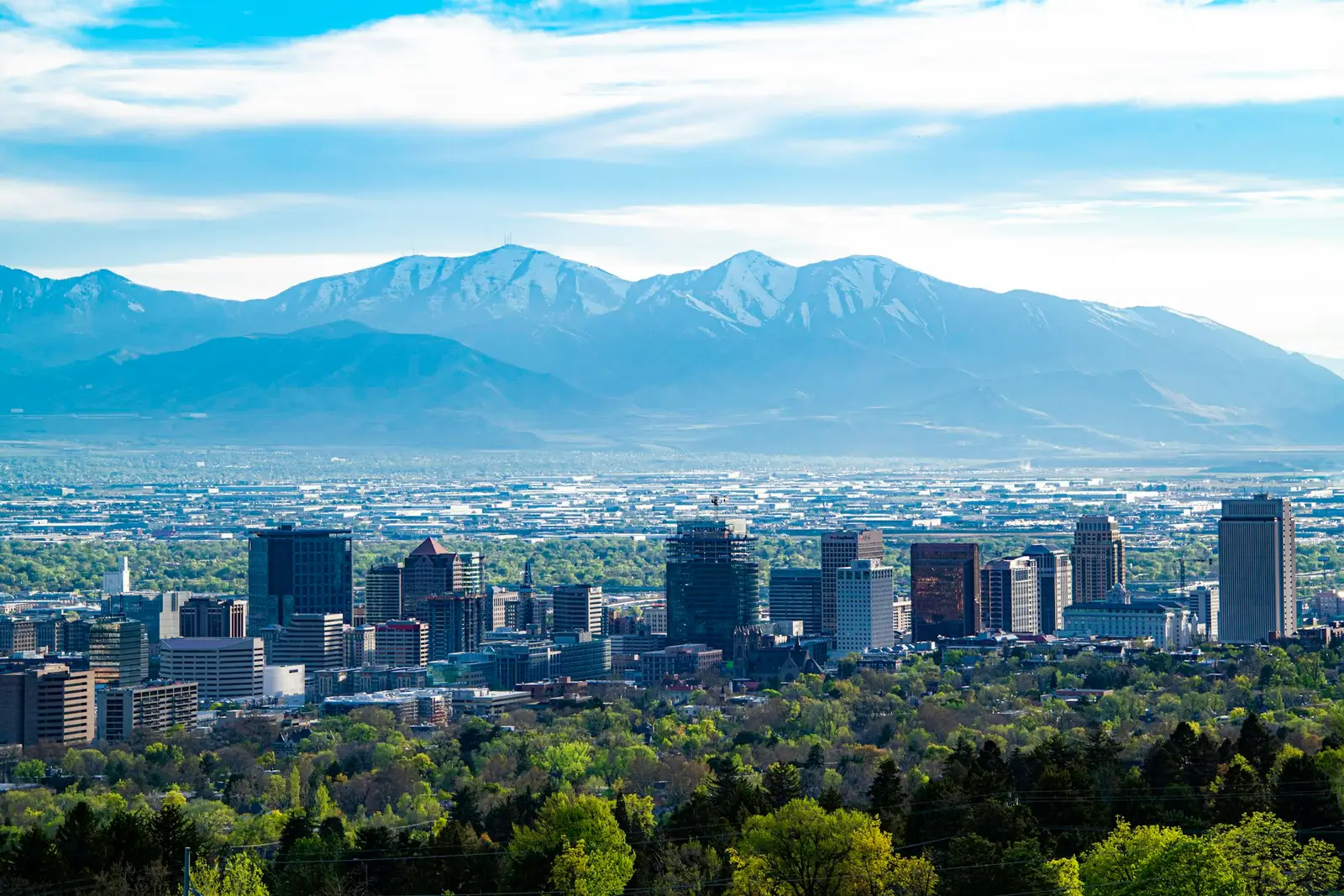
Canyon water from the Wasatch
Salt Lake City Public Utilities gets most of its water from the mountains that rise right behind the city. Streams in City Creek, Parleys, Big Cottonwood and Little Cottonwood canyons feed treatment plants built at or near the canyon mouths: the City Creek plant above the Avenues, the Parleys plant near the mouth of Parleys Canyon, and the Big Cottonwood plant at the mouth of that canyon. Little Cottonwood water is treated by the Metropolitan Water District of Salt Lake and Sandy, and the city also draws on Deer Creek Reservoir supplies through the Provo River system and on a network of wells.
Snowmelt in spring keeps the water relatively soft for Utah standards. As streams drop through late summer and fall, the utility relies more on wells and reservoir water, and hardness climbs. Many east bench homes notice heavier white spotting on fixtures in August than in May.
Inside a water heater, that calcium settles as gritty sediment and coats electric elements. On a gas tank it eventually produces the popping and crackling that Salt Lake homeowners know well. Tankless units here generally need descaling every year, and many homeowners add a water softener to protect them.
Avenues basements and west side bungalows
The Avenues, Capitol Hill and the Marmalade District hold some of the city's oldest homes, from Victorian brick cottages to early twentieth century foursquares stacked up the slope above downtown. Nearly all have basements, and the water heater normally sits there, sometimes reached by a narrow outside cellar stair. Federal Heights and the Yalecrest neighborhood add larger brick period-revival homes with finished basements.
Sugar House, Liberty Wells and the 9th and 9th area are filled with brick bungalows and post-war cottages, again with basement installs that often share a chimney with an aging furnace. On the west side, Rose Park, Glendale and Poplar Grove have many 1940s and 1950s brick ramblers with basements or utility rooms, and a number of these houses still run their original gas lines.
Newer townhomes and apartments downtown, in the Granary District and along the TRAX lines tend to use closet-mounted tanks or tankless units with direct venting through an outside wall.
Altitude, inversions and the Wasatch Fault
At roughly 4,300 feet in the valley and higher on the benches, air is thinner than at sea level, so gas appliances are derated or set up for elevation. A replacement heater should be one the manufacturer rates for the altitude, with burner and venting set up accordingly.
Winter inversions trap pollution along the Wasatch Front, and Utah has adopted air quality rules that push gas water heaters sold in the area toward low-NOx burners. Your plumber should install a compliant model.
Most important, the Wasatch Fault runs along the east edge of the valley. The March 2020 Magna earthquake, magnitude 5.7, shook homes across the valley and cracked chimneys and parapets. Utah's plumbing code requires seismic straps on water heaters, and an unstrapped tank that tips can sever its gas line during a quake.
The problems plumbers see most in Salt Lake City
- Crackling gas tanks packed with calcium sediment from late-summer well and reservoir water.
- Scaled tankless heat exchangers throwing error codes in Sugar House and downtown condos.
- Missing or loose earthquake straps on basement heaters in the Avenues and Rose Park.
- Burners set up wrong for altitude after a heater bought elsewhere was installed without adjustment.
- Shared chimney venting problems after a Sugar House or Avenues furnace swap leaves the heater alone in an oversized flue.
- Burst lines in crawlspaces and garages during January cold that settles into the valley.
Typical water heater prices in Salt Lake City
| Job | Typical Salt Lake City range | Notes |
|---|---|---|
| Thermocouple, pilot or igniter repair | $150–$300 | |
| Gas control valve | $300–$575 | |
| Electric element and thermostat | $150–$350 | Scaled elements are common |
| Flush and descale | $120–$275 | |
| Earthquake straps and expansion tank | $175–$425 | |
| 40–50 gallon gas tank replacement | $1,500–$3,300 | Low-NOx model, permit usually included |
| Tankless gas installation | $3,200–$6,000 | Altitude-rated unit and venting |
Salt Lake rates are moderate for a western metro, though the region's fast growth has pushed them up. Carrying a tank down an outside cellar stair in the Avenues, relining an old chimney, adding a softener or calling during a holiday cold snap all increase the cost.
Utah DOPL licensing and Salt Lake permits
Utah's Division of Professional Licensing, known as DOPL, licenses journeyman and master plumbers and also licenses plumbing contractors. A company replacing your heater should hold a contractor license that covers plumbing, and you can confirm both the company and the individual on DOPL's online license lookup.
Inside city limits, Salt Lake City's Building Services division issues permits for water heater replacement, and many applications go through the city's online permit portal. Inspectors check straps, venting, the gas connection, the relief valve discharge and an expansion tank if the service has a pressure reducer. Millcreek, South Salt Lake and other neighboring cities issue their own permits.
Enbridge Gas, Rocky Mountain Power and choosing a heater
Natural gas in Salt Lake City comes from Enbridge Gas Utah, the utility long known as Questar Gas and later Dominion Energy Utah. Gas has historically been inexpensive along the Wasatch Front, and gas tanks dominate in older city homes. Enbridge has offered efficiency rebates on certain water heaters at times.
Electricity comes from Rocky Mountain Power. Heat pump water heaters fit well in a roomy basement and run efficiently in Salt Lake summers, though cold basements in winter slow them. Rocky Mountain Power's Wattsmart programs have offered incentives at times, so check before buying.
Living with hard canyon water
Draining several gallons from the tank every six months or so keeps the worst of the calcium from building up, and a full flush makes sense if a tank already crackles. On Salt Lake water, magnesium anodes wear steadily, so pull and look at the rod partway through the heater's life. Homes with a softener should check the anode more often, since softened water consumes it faster.
For tankless owners, an annual vinegar or descaling solution flush through the service valves is part of normal upkeep in Salt Lake City, not an optional extra.
Repair or replace in Salt Lake City
Valves, thermocouples, igniters and elements are usually worth replacing on a heater under eight years old. Salt Lake tanks often last 8 to 12 years, shorter on hard water that is never flushed. If a basement tank is rumbling loudly, seeping at the base or producing rusty hot water, it is time to replace it before it fails, and that is a good moment to add straps, an expansion tank and a softener if the house lacks them.
Around Salt Lake City
Sandy has its own water department, and West Valley City and Murray run separate utilities and building departments. Millcreek, Holladay and South Salt Lake issue their own permits even where Salt Lake City water flows in their pipes. North in Davis County, Bountiful draws on a different mix of wells and canyon water. Any of them still requires a DOPL-licensed plumbing contractor.
Water heater questions from Salt Lake City
Why is Salt Lake City water harder in late summer?
As canyon streams fall after the snowmelt peak, the utility leans on wells and reservoir water, which carry more calcium.
Do water heaters need earthquake straps in Salt Lake City?
Yes. Utah's plumbing code requires seismic restraint, and the Wasatch Fault and the 2020 Magna quake make it essential.
Does the 4,300-foot elevation change how my gas heater runs?
Yes. At about 4,300 feet a gas burner needs the right setup for altitude. Have a plumber confirm the model is rated for your elevation.
How do I check a Utah plumber's license?
DOPL's online search shows whether the company and the plumber at your door both hold current Utah licenses.
Who is my gas utility in Salt Lake City?
Enbridge Gas Utah, formerly Dominion Energy Utah and Questar Gas before that.
Should I install a water softener with a new heater?
On Salt Lake water, a softener protects tankless units and reduces sediment. Check the anode more often if you add one.
Why does my Avenues basement heater pop and crack?
Calcium sediment on the tank bottom traps water that boils against the burner. A flush may quiet it, but persistent noise often signals an aging tank.