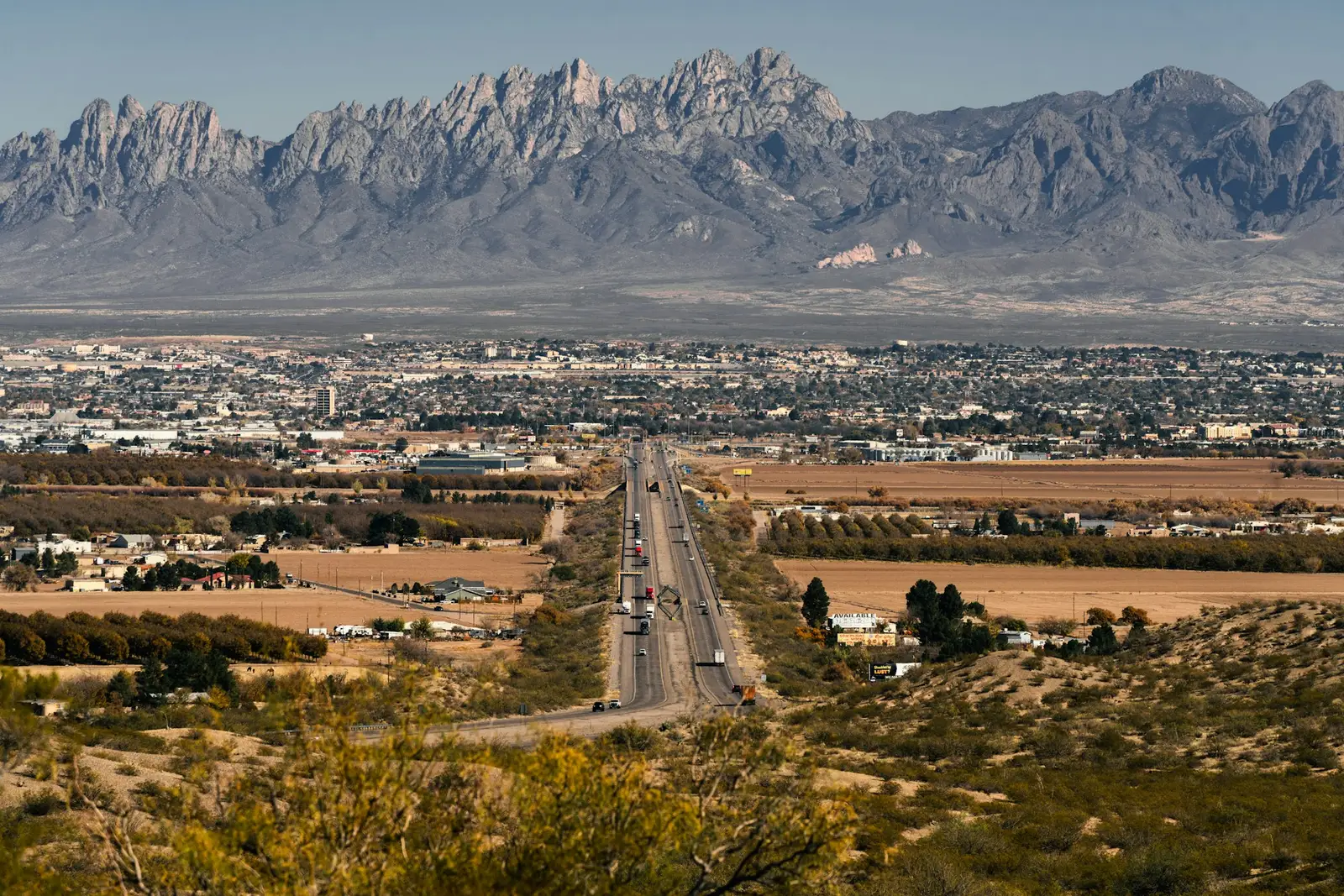
Groundwater under the Mesilla Valley
Although the Rio Grande runs along the west side of town, Las Cruces does not drink from the river. River water in the valley is committed to irrigation for pecan orchards, chile and cotton fields, so the city relies on dozens of municipal wells. Most pump from the Mesilla Bolson, the thick basin of sand and gravel under the valley, while wells on the East Mesa reach into the Jornada del Muerto Bolson that stretches north and east toward the Organ Mountains.
Some of that groundwater naturally carries arsenic above the federal limit, so Las Cruces Utilities built treatment facilities to remove it before the water enters the system. The water that comes out is safe, but it is still loaded with calcium and other dissolved minerals. Hardness varies from moderate to very hard depending on the well, and some neighborhoods notice heavy white spotting on fixtures while others see much less.
Because groundwater stays close to the same temperature year round, Las Cruces inlet water rarely gets truly cold. That eases the load on a heater in winter compared with northern New Mexico, but the minerals keep collecting whether the incoming water is 60 degrees or 80.
Adobe, stucco and garage heaters
The older core of Las Cruces, including the Mesquite and Alameda-Depot historic districts near downtown, has adobe and brick homes from the early twentieth century, many with water heaters in a back room, a closet on an enclosed porch or a small outbuilding. Flat roofs with parapets are common, and the vent pipe that pokes through them needs good flashing to keep monsoon rain out of the burner.
Neighborhoods built from the 1960s onward around New Mexico State University, in Mesilla Park and on the near East Mesa are mostly single-story stucco ranch homes where the heater sits in an attached garage. Newer master-planned areas such as Sonoma Ranch, Metro Verde and Picacho Hills follow the same pattern with larger gas tanks or tankless units. Manufactured homes are common on the city's edges and in Doña Ana County, usually with a heater in a small exterior compartment.
NMSU also supports a big rental market, with duplexes and small houses near University Avenue and El Paseo Road rented to students. Heaters in those rentals often run hard for years with little maintenance.
Desert heat, monsoons and the odd freeze
Las Cruces summers regularly top 100 degrees, and a closed garage on the East Mesa can climb well past that. Heat dries out plastic parts, stresses gas control seals and wears out temperature-and-pressure relief valves early. Summer monsoon storms from July through September then bring wind, dust and sudden rain, and blowing grit finds its way into burner air intakes.
Winters are mild by day, but clear desert nights can drop well below freezing for a few hours. Heaters in exterior closets or manufactured-home compartments are the most exposed, and a cold snap now and then catches uninsulated pipes. A small heat lamp or pipe wrap near an outside closet is a reasonable precaution.
At roughly 3,900 feet, Las Cruces is high enough that gas appliance ratings matter. Heaters sold in the area are generally built to handle the elevation, but a unit brought in from a low-elevation market or fitted with the wrong replacement orifice can burn poorly and leave soot.
The problems plumbers see most in Las Cruces
- Heavy calcium scale in tanks on the hardest well fields, causing rumbling and slow recovery.
- Failed electric elements in manufactured homes and older rentals.
- Heat-cracked drain valves and relief valves in summer garages.
- Dusty burners after monsoon windstorms.
- Leaky roof vents on flat-roofed adobe and stucco homes during summer storms.
- Tankless units clogged with scale because nobody descaled them.
Typical water heater prices in Las Cruces
| Job | Typical Las Cruces range | Notes |
|---|---|---|
| Thermocouple, igniter or pilot repair | $140–$300 | |
| Gas control valve replacement | $275–$525 | |
| Electric element and thermostat repair | $150–$325 | |
| Flush and descale | $100–$250 | Tankless descale similar |
| 40–50 gallon gas tank replacement | $1,250–$2,700 | Permit usually included |
| Manufactured home heater replacement | $950–$2,100 | |
| Tankless installation | $2,900–$5,500 | Softener recommended |
Las Cruces labor costs are lower than in Albuquerque or El Paso's busiest neighborhoods. Expect to pay more for flat-roof vent repairs, heaters in tight adobe closets and jobs in Picacho Hills or other outlying areas where travel time adds up.
Licensing and Las Cruces permits
In New Mexico, plumbing and gas work falls under the Construction Industries Division, part of the state Regulation and Licensing Department. A company replacing a water heater should hold a CID contractor license with the right plumbing and gas classification, and the person doing the work should carry a journeyman certificate. CID offers an online search where you can check a contractor's license status.
Within city limits, the City of Las Cruces handles building and plumbing permits through its community development office, and an inspector checks venting, gas connections and the relief valve discharge line. Homes in unincorporated Doña Ana County fall under the county or CID's own inspectors, so the permit process depends on the address. A reputable plumber will tell you which office handles yours.
Utilities run by the city
Las Cruces is unusual in that Las Cruces Utilities provides natural gas as well as water, wastewater and trash service. A gas odor near the heater calls for getting outside and dialing the utility's emergency line rather than the plumber first. Gas lines in some older neighborhoods are decades old, and a gas leak check is a sensible part of any replacement.
Electricity comes from El Paso Electric, which serves the Mesilla Valley along with El Paso. Electric water heaters are common in manufactured homes and some apartments. Heat pump water heaters can perform well in Las Cruces garages, since those spaces rarely get cold, and the utility has offered efficiency programs at times.
Repair or replace in Las Cruces
Valley homeowners with a heater younger than about eight years generally get good value from swapping a failed igniter, thermocouple, control valve or element. On the hardest Las Cruces wells, though, an undrained gas tank can grow a mineral bed thick enough to overheat the bottom of the tank, and once that tank starts weeping, no repair will save it.
If you are already replacing a heater, consider a whole-house softener or at least a scale-reducing filter, and ask about a model with a self-cleaning dip tube or a larger drain valve. Those small upgrades make the yearly flush far easier on Mesilla Valley water.
Around Las Cruces
Mesilla, the historic town just southwest of Las Cruces, has its own water system and permit office. Doña Ana village to the north, Fairacres and Radium Springs rely on local water associations or private wells, often very hard. Santa Teresa, Sunland Park, Anthony and Chaparral to the south have separate water systems, and many homes there are manufactured housing with compact water heaters.
Water heater questions from Las Cruces
Why does my Las Cruces water heater rumble?
Calcium from the city's wells forms a crust at the bottom of the tank, and pockets of water beneath it flash to steam as the burner fires. Draining the tank once or twice a year keeps the layer thin.
Does arsenic treatment affect my water heater?
No. The treatment removes arsenic before the water reaches you. What affects your heater is the hardness, which the treatment does not remove.
Who do I call for a gas smell in Las Cruces?
Leave the house and call Las Cruces Utilities, which runs the city's gas system. A licensed plumber can fix the heater once the leak is secured.
Who licenses plumbers in Las Cruces?
The New Mexico Construction Industries Division licenses contractors and certifies journeyman plumbers and gas fitters statewide.
Does elevation matter for gas heaters in Las Cruces?
Somewhat. At about 3,900 feet, the burner should be rated or adjusted for the elevation, and replacement parts must match.
Can a Las Cruces garage support a heat pump water heater?
Often, yes. Mesilla Valley garages seldom get cold enough to slow a heat pump, though they still need regular flushing on hard water.
How long do water heaters last in Las Cruces?
Gas tanks commonly last eight to twelve years. Homes on the hardest wells, or those that never flush, see shorter lives.