Where Simi Valley's water comes from
Two retail providers split the city. Ventura County Waterworks District No. 8 serves the larger share of Simi Valley homes; despite the county name, the City of Simi Valley operates it, with the City Council sitting as the district board. Golden State Water Company, an investor-owned utility, runs a separate system that covers several older neighborhoods. The name printed on your water bill identifies the provider, which matters for leak notices, shutoff calls and pressure complaints.
Both buy nearly all of their supply from Calleguas Municipal Water District, which in turn purchases State Water Project deliveries from Metropolitan, the big regional wholesaler. Calleguas treats much of that water at its Lake Bard Water Filtration Plant beside Lake Bard reservoir, off Wood Ranch Parkway, and also receives water already filtered at Metropolitan's Jensen plant in Granada Hills. Local groundwater under the valley is high in minerals and plays only a small role in drinking supply.
State Project water picks up salts on its long trip through the Sacramento-San Joaquin Delta and the California Aqueduct, so it arrives hard. In a Simi Valley garage that means white crust on the cold inlet nipple, gritty sediment at the drain valve, and a tankless unit that can lose flow within a year or two if nobody descales it. Many households here run a water softener, which protects the heater but can speed up anode wear, so the two should be considered together.
Tract homes and garage heaters
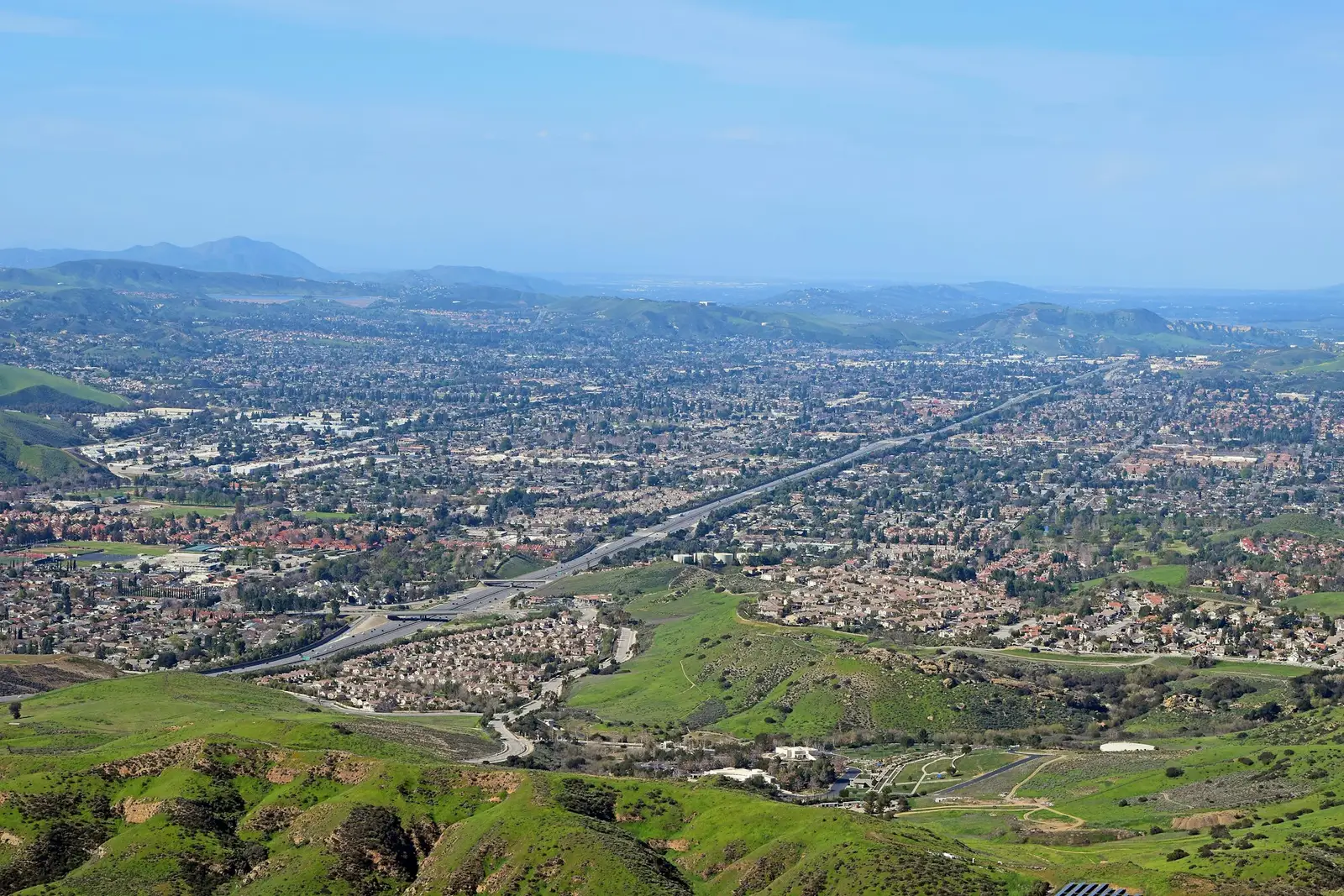
Most of Simi Valley went up around and after its 1969 incorporation, as former ranch and orchard land gave way to subdivisions. Builders filled the valley floor with single-story ranches and two-story tract homes through the 1970s and 1980s, then moved up the slopes into Wood Ranch, Big Sky and Lost Canyons in the 1990s and 2000s. Older pockets near Royal Avenue and Tapo Street date to the late 1950s and early 1960s.
In nearly all of these homes you will find the tank out in the attached garage, typically against the wall it shares with the laundry room or kitchen. California code requires gas heaters in garages to sit on an 18-inch platform so the burner stays above gasoline vapors, and many Simi Valley stands are original wood frames that have soaked up years of drips. Some 1980s two-story plans put a 40-gallon tank in an interior closet or even an attic, which raises the stakes when a tank finally leaks.
Condominium and townhome complexes along Cochran Street, Erringer Road and Sycamore Drive often have heaters on small exterior closets or patios. Those units take the full summer sun and the dry east winds, and their vent caps and door louvers tend to age faster than the tank itself.
Earthquake straps and the Northridge lesson
The epicenter of the January 17, 1994 Northridge earthquake lay just over the Santa Susana Mountains, and Simi Valley took heavy shaking. Chimneys cracked, block walls fell, and unbraced water heaters tipped over, snapping gas lines and flooding garages. That experience is why Simi Valley inspectors pay close attention to seismic strapping, and why so many local owners ask about it before anything else.
State law requires every water heater to be braced against earthquake motion, with a pair of straps (one near the top, the other near the bottom) anchored into studs or masonry. Flexible gas and water connectors are part of the same safety package. A plumber replacing a heater here should also add or verify a seismic gas shutoff valve if the home has one, and check that the platform underneath can carry a full tank when the ground moves.
Heat, wind and wildfire
Summer afternoons in Simi Valley regularly pass 100 degrees, and a closed garage can get hotter still. Gas control valves, plastic drain valves and rubber gaskets wear faster in that heat. Santa Ana wind events push dust and ash into burner chambers and can blow out pilots on older standing-pilot tanks whose vent caps face the east.
Fire comes close more often than many newcomers expect. The 2003 Simi Fire burned across the hills north of the city, the 2018 Woolsey Fire started near the Santa Susana Field Laboratory south of town, and the 2019 Easy Fire threatened homes and the Reagan Library on the west end. After a fire or a public safety power shutoff from Southern California Edison, heaters with electronic ignition, power-vent fans or heat pump compressors may need a reset. When SoCalGas shuts off service in an evacuation zone, only the utility or a qualified technician should restore gas and relight appliances.
The problems plumbers see most in Simi Valley
- Scale-choked tankless units that drop to a trickle after a year or two on hard Calleguas water.
- Rotted wooden garage platforms under tanks that have dripped from the relief valve for years.
- Missing or loose seismic straps on heaters installed before the current rules, or swapped without a permit.
- Heat-stressed gas controls and valves in west-facing garages through August and September.
- Pinhole leaks in attic or closet heaters in 1980s two-story homes, where the damage spreads to ceilings below.
- Fouled burners and pilots after Santa Ana winds or fire season drop dust and ash into the combustion chamber.
Typical water heater prices in Simi Valley
| Job | Typical Simi Valley range | Notes |
|---|---|---|
| Thermocouple, pilot or igniter repair | $185–$350 | Standing-pilot and electronic ignition |
| Gas control valve replacement | $425–$700 | Parts vary by brand |
| Flush or tankless descale | $150–$325 | Descale is a frequent need on this water |
| Seismic straps, platform and connectors | $175–$600 | Often found during inspections |
| 40–50 gallon gas tank replacement | $1,900–$3,600 | Permit, straps and haul-away |
| Heat pump water heater installation | $3,800–$6,500 | Electrical work may be extra |
| Tankless installation | $4,200–$7,500 | Gas line upsizing is common |
Labor in eastern Ventura County runs a bit below Los Angeles but above the Central Valley. Attic or closet locations, a new platform, or a meter run too small to feed a tankless unit push a Simi Valley job toward the top of these bands.
Licensing and Simi Valley permits
California's Contractors State License Board issues plumbing licenses, normally in the C-36 class, and its online lookup shows a contractor's status, bond and complaint history. Simi Valley issues its own permits from the Building and Safety counter at City Hall on Tapo Canyon Road. Inspectors there look at seismic bracing first, then gas piping, flue pipe, the discharge point of the T&P line and, if the house needs one, an expansion tank.
Before booking, confirm that the contractor's quote names the permit and the final inspection. Homes in unincorporated Santa Susana Knolls or Box Canyon fall under Ventura County's building office instead of the city. New gas heaters also have to meet low-NOx limits set by the Ventura County Air Pollution Control District, which reputable installers handle by choosing compliant models.
Choosing a replacement for a Simi Valley home
A family of four in a three-bedroom tract house usually does well with a 50-gallon gas tank, because winter supply water near 55 degrees is mild compared with colder climates. Larger Wood Ranch and Big Sky homes with soaking tubs often step up to a 75-gallon tank or a tankless unit. If you go tankless, plan on a softener or a yearly descale, since the valley's water will shorten the life of the heat exchanger otherwise.
Simi's warm garages give heat pump water heaters plenty to work with, since they pull heat from the surrounding air and actually cool the space a little in summer. Southern California Edison and state programs have offered rebates on these units at times, and the panel and circuit work they need is worth pricing in. Solar water heating also turns up on some homes in the eastern hills, and those systems need a plumber who knows their valves and backup tanks.
Repair or replace in Simi Valley
Hard water shortens tank life here compared with soft-water cities, so age deserves more weight. Replacing a thermocouple, igniter or relief valve still makes sense on a Simi Valley tank younger than about eight. Beyond roughly the ten-year mark, rust weeping at the base, a rumble that a flush no longer quiets, or a leak at the tank seam points to replacement. For an attic or second-floor closet heater, many owners replace a little early rather than risk a ceiling collapse.
If your garage platform is soft or the straps are missing, those fixes often make sense along with any repair, because an inspector will flag them at the next permit anyway. Persistent popping and crackling usually points to minerals settling on the tank bottom, and a flush may buy time on a younger unit.
Around Simi Valley
Moorpark, just west through the Arroyo Simi corridor, gets water from Ventura County Waterworks District No. 1 and handles permits through its own city. Thousand Oaks and Newbury Park to the south have a mix of city, Cal Water and California American Water service. Over the Santa Susana Pass, Chatsworth and Porter Ranch belong to the City of Los Angeles, so LADWP supplies their water and LADBS handles permits. Oak Park is unincorporated Ventura County, served by Calleguas water through a separate district.
Water heater questions from Simi Valley
Who supplies water to my Simi Valley home?
Most homes are served by Ventura County Waterworks District No. 8, and others by Golden State Water Company. Both resell imported water from Calleguas, so the hardness is similar.
Why does my Simi Valley tankless heater keep losing flow?
Imported State Water Project water is hard, and scale builds inside the heat exchanger. Most units here need descaling about once a year unless the home has a softener.
Do Simi Valley inspectors check earthquake straps?
Yes. Two straps, flexible connectors and a sound platform are part of every replacement inspection, a lesson reinforced after the Northridge quake.
Does a garage water heater in Simi Valley need to be raised?
A gas heater in a garage must keep its burner at least 18 inches above the floor, which usually means a sturdy platform.
My pilot went out after the Santa Ana winds. Is that normal?
Strong east winds can blow back through vent caps and snuff a standing pilot. Relight it per the label once the wind drops, and call a plumber if it keeps going out.
Can I relight my heater after SoCalGas restores service from an evacuation?
Let SoCalGas or a licensed plumber relight appliances after a utility shutoff. They check for leaks and smoke damage at the same visit.
Could a Simi Valley garage host a heat pump heater?
Usually, yes. Warm garages give them plenty of heat to work with, and Edison has offered incentives at times.