Lawrence's Merrimack River supply
Lawrence has drawn its drinking water from the Merrimack since the nineteenth century, and today the city runs its own treatment plant to clean that river water before it reaches homes. Because the Merrimack carries runoff from a huge watershed in New Hampshire and northern Massachusetts, the plant relies on conventional coagulation, filtration and disinfection to deal with swings in turbidity after storms and spring melt. Lawrence sits farther downstream than any other Massachusetts town using the river as its only source.
Finished water is soft and fairly low in minerals. That means tanks rarely build heavy lime crust, and tankless heaters can stretch longer between descales. Soft water does tend to be more aggressive toward anode rods, though, so Lawrence tanks often use up their sacrificial anode sooner than owners expect. Silt and rust knocked loose by main replacements in the street also find their way into heaters.
Triple-deckers, mills and South Lawrence homes
Lawrence is one of the most densely built cities in New England. Tower Hill, Prospect Hill, the Arlington district, North Common and the Lower Tower Hill streets near the Spicket River are lined with triple-deckers, each floor typically fed by its own gas water heater standing in a shared cellar. Three heaters, a boiler or two and a tangle of vent pipe often share a single brick chimney, and many cellars have rubble or fieldstone foundations that sweat through the summer.
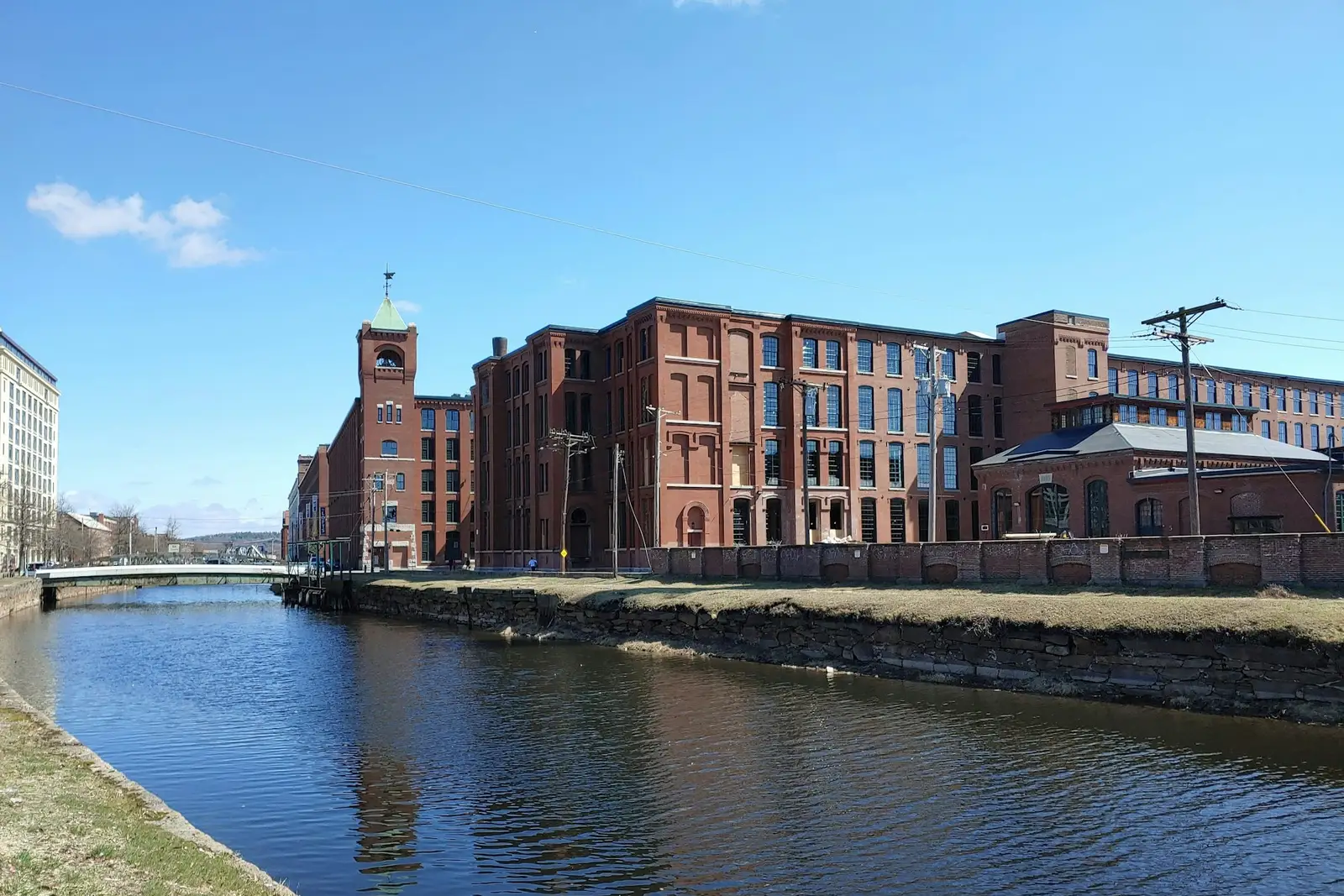
Along the North and South canals, the brick mills that once made Lawrence the worsted wool capital of the world, from the Everett Mills to the Ayer Mill with its big clock tower, have been converted into apartments, studios and offices. Units there usually rely on compact electric tanks or small tankless heaters tucked in utility closets.
South Lawrence, across the Merrimack, is more suburban, with capes, ranches and two-family homes on wider lots. Its basements tend to be roomier, and its heaters face a different history because of what happened there in 2018.
After the 2018 Merrimack Valley gas explosions
On September 13, 2018, over-pressurized gas lines operated by Columbia Gas of Massachusetts caused a chain of explosions and fires across South Lawrence, Andover and North Andover. A Lawrence teenager was killed, many people were hurt, and thousands of households went without gas for weeks while the lines were rebuilt. During that restoration, large numbers of furnaces, boilers and water heaters in affected Lawrence homes were replaced.
Gas service in the area has since moved to Eversource, which took over the Columbia Gas Massachusetts business in 2020. For homeowners, two practical points remain. First, a big batch of South Lawrence heaters was installed during the same few months, so many of them are reaching the age where anodes are spent and tank leaks start to appear. Second, residents understandably take any gas smell seriously; if you smell gas near a water heater, leave the house and phone Eversource's emergency number once you are out on the sidewalk, and only then line up a plumber.
The problems plumbers see most in Lawrence
- Aging post-2018 replacement heaters in South Lawrence, many now old enough to start leaking at the base.
- Overcrowded chimneys where three triple-decker heaters and a boiler feed one flue.
- Spent anode rods on soft Merrimack water, leading to smelly hot water or early tank corrosion.
- Frozen supply lines along exposed back porches and street-side cellar walls in January.
- Flooded burners in low cellars near the Spicket River after heavy rain.
- Short hot water in winter for a small third-floor tank fed by near-freezing Merrimack water.
Typical water heater prices in Lawrence
| Job | Typical Lawrence range | Notes |
|---|---|---|
| Thermocouple or pilot assembly | $175–$350 | Common on rental tanks |
| Gas control valve | $425–$700 | Licensed gas fitter required |
| Anode rod replacement | $175–$325 | Worth it on soft water |
| Flush and drain valve | $125–$275 | |
| Chimney liner work | $450–$1,300 | Multi-appliance flues cost more |
| 40–50 gallon gas tank replacement | $1,750–$3,400 | Permit and removal included |
| Tankless installation | $3,800–$6,800 | Venting and gas line sizing vary |
Merrimack Valley labor rates sit somewhat below Boston's. Triple-decker cellars push jobs up: three tanks may need to be replaced at once, stairs are often steep, and a shared chimney may have to be relined before the city inspector will approve a new heater.
Permits and Massachusetts licenses
Massachusetts treats a water heater swap as both plumbing and gas work. A licensed plumber or gas fitter must take out a permit with Lawrence's Inspectional Services Department, and the city's plumbing and gas inspector checks the connections, venting and relief valve discharge after installation. Plumbing and gas fitting licenses in Massachusetts come from one state examining board, and homeowners cannot legally do the gas work themselves.
Landlords should keep permit records on file for each unit, as the city's code enforcement inspections may ask for them. Andover, Methuen and North Andover each run their own inspection departments and permit fees.
Mass Save, National Grid and Eversource
Lawrence households buy electricity from National Grid and gas from Eversource. Both utilities take part in Mass Save, the statewide efficiency program, whose incentives for heat pump and condensing gas heaters have come and gone at times. Income-eligible owners and renters in Lawrence may also qualify for no-cost upgrades through local community action programs. Check the current offers before choosing a model.
Heat pump water heaters need space and steady temperatures. They may work in a South Lawrence basement but are harder to fit in a crowded triple-decker cellar shared with two other tanks and a boiler.
Winter and flood exposure
Merrimack Valley winters bring long stretches of single-digit nights. Triple-deckers often have plumbing running along uninsulated rear porches or back stairwells, and those pipes freeze first. A heater that suddenly runs out of water pressure on a frigid morning may be connected to a frozen line rather than broken itself.
The Spicket River runs through the north side of the city into the Merrimack, and low-lying blocks near it have flooded in major storms, including the Mother's Day floods of 2006 that hit much of the valley. Any Spicket-side heater that took on water should stay off until a gas fitter opens it up, and replacement is the normal recommendation for a submerged gas control.
Repair or replace in Lawrence
For a heater under about eight years old, most thermocouple, gas valve and relief valve problems are worth repairing. Past roughly ten years, or once rust and dampness appear around the base, a Lawrence owner is better off pricing out a full replacement. Owners of the many South Lawrence tanks installed in late 2018 should have them checked now, since a planned swap is far cheaper than cleaning up after a burst tank.
Around Lawrence
Methuen wraps around Lawrence's north side and treats its own Merrimack water. Andover and North Andover to the south were also hit in 2018 and run separate water systems and inspection offices. Haverhill lies downriver with its own reservoir supply, and Salem, New Hampshire is just over the state line, where New Hampshire licensing rules apply.
Water heater questions from Lawrence
My South Lawrence water heater was installed in 2018. Should I replace it?
Not automatically, but have it inspected. Many tanks from that restoration period are now old enough to show anode wear or early leaks.
Who provides gas in Lawrence now?
Eversource. It took over the Columbia Gas of Massachusetts business in 2020, after the 2018 explosions.
Is Lawrence tap water hard?
No. Merrimack water leaves Lawrence's plant low in calcium, and lime buildup ranks well below sediment and anode wear as a heater concern.
Does Lawrence Inspectional Services have to approve a heater swap?
Yes. A licensed plumber or gas fitter files the permit with Inspectional Services, and the work is inspected afterward.
Why does my Lawrence hot water smell like rotten eggs?
Soft water can wear down the anode rod and react with it, producing sulfur odors. Replacing the anode, sometimes with a different type, usually solves it.
There's a gas odor by the heater in my cellar. What now?
Leave the building, then call Eversource's emergency number from outside. Leave lights, switches and the pilot alone until crews clear the house.
How much does a gas water heater replacement cost in Lawrence?
A typical 40 or 50 gallon gas tank runs about $1,750 to $3,400, including the city permit, removal and code updates.