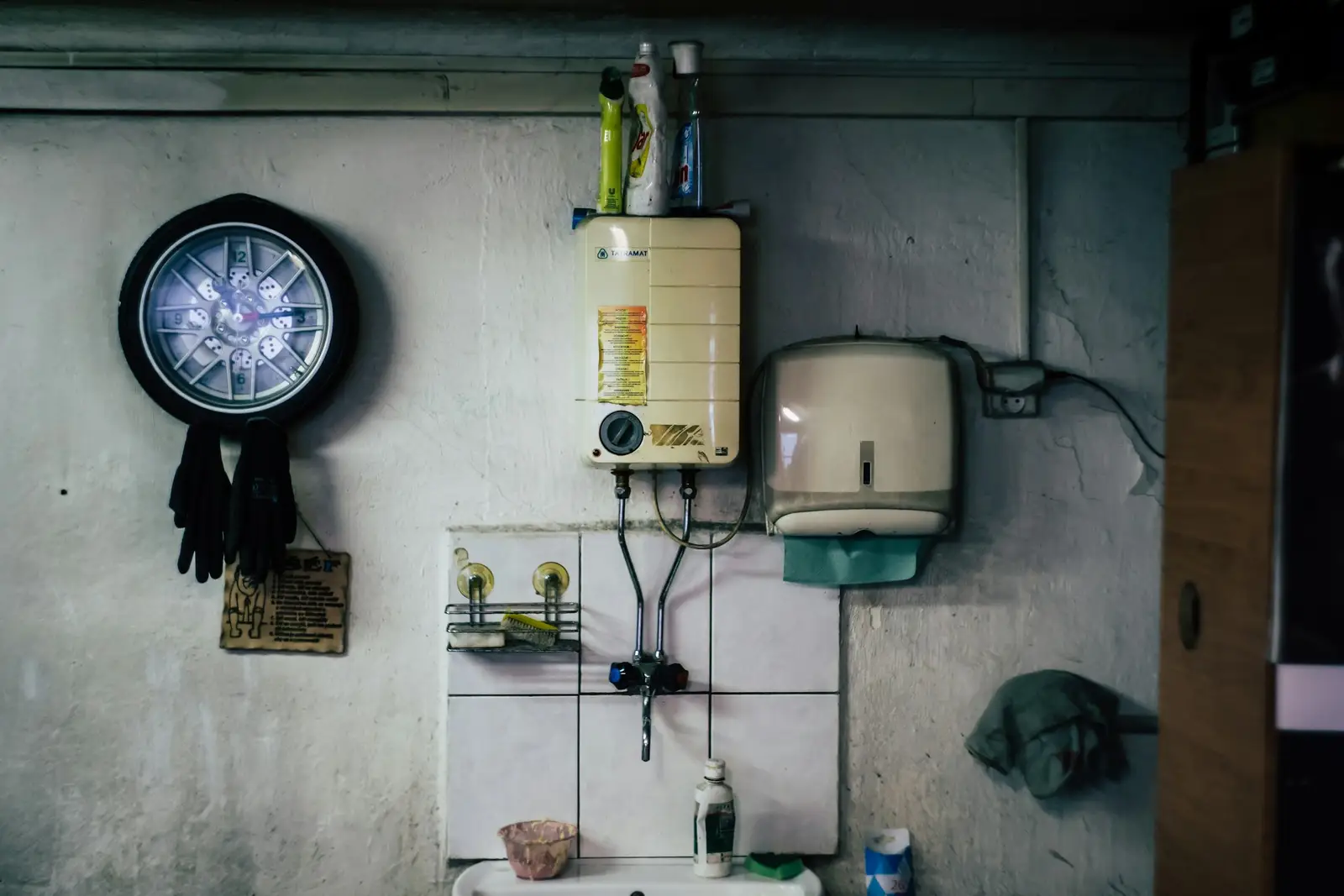
Unit price vs installed price
Shoppers often see a $1,200 tankless heater online and expect a $2,000 installed bill. In practice, the unit is usually 30 to 45 percent of the total. The rest is labor, materials and the changes your house needs to feed the heater enough fuel and get rid of its exhaust.
| Type | Unit only | Typical installed | Where it fits |
|---|---|---|---|
| Gas, non-condensing, whole house | $900–$1,800 | $2,800–$5,500 | Replacing an existing tankless, or homes with metal vent paths |
| Gas, condensing, whole house | $1,300–$2,800 | $3,200–$6,500 | Most new conversions; PVC venting and higher efficiency |
| Gas combi or with built-in recirculation | $2,000–$3,500 | $4,000–$7,500 | Homes wanting instant hot water at far fixtures |
| Electric, whole house (18–36 kW) | $600–$1,500 | $2,000–$5,500 | Warm-climate homes with 200 amp service or room to upgrade |
| Electric, point of use (3–10 kW) | $200–$600 | $400–$1,200 | A single sink or a remote bathroom |
Replacing an old tankless with a new one of the same fuel and vent type is the cheapest scenario, because the gas line, vent and drain are already sized. A first-time conversion from a tank is where the bigger numbers come from.
Condensing vs non-condensing
A condensing unit uses a second heat exchanger to pull extra heat out of the exhaust before it leaves the house. The exhaust comes out cool enough to run in PVC or polypropylene pipe, which is cheaper and easier to route than stainless steel. The trade-off is acidic condensate that has to be drained, usually through a small neutralizer cartridge to a floor drain, laundry standpipe or condensate pump.
A non-condensing unit is simpler and a little cheaper to buy, but its hot exhaust needs Category III stainless steel venting, which can cost $300 to $1,000 more than PVC on a long run. For most first-time conversions, the condensing unit ends up costing about the same installed and delivers better efficiency, so it is what many plumbers recommend.
Gas line upsizing
This is the line item that most often turns a reasonable quote into a large one. A 50 gallon gas tank uses roughly 40,000 BTU per hour. A whole-house tankless unit fires at up to 150,000 to 199,000 BTU. The half-inch pipe that fed your tank is almost never large enough for that, especially if the furnace, range and dryer share the same line.
- Short run from the meter, easy access: $300 to $700 to run a new three-quarter-inch or one-inch line.
- Long run through finished walls or ceilings: $800 to $2,000, sometimes more if drywall must be opened and patched.
- Meter or regulator upgrade: Some homes need the gas utility to install a higher-capacity meter or switch to elevated pressure. The utility work may be free or may carry a fee, and it can add days or weeks to the schedule.
Flexible corrugated stainless tubing (CSST) can bring the cost down on difficult routes, but it must be bonded to the electrical grounding system, which adds a small cost. A plumber who quotes without measuring the gas run and checking the meter rating is guessing.
Venting and condensate
A tank heater with an atmospheric vent sends exhaust up a chimney or a B-vent. A tankless unit cannot share that path. It needs its own sealed vent, normally through a side wall or the roof.
- Side-wall PVC vent for a condensing unit: $200 to $600 in most homes.
- Roof penetration or a long run through an attic: $500 to $1,500.
- Stainless steel vent for a non-condensing unit: $600 to $1,800 depending on length.
- Condensate neutralizer and drain: $100 to $350, or more if a pump is needed.
- Abandoned chimney liner: If the tank shared a masonry chimney with a furnace, removing the tank can leave the furnace's flue oversized. Correcting it can add $300 to $1,500 and is a code issue, not an option.
Wall terminations also have to sit set distances from windows, doors, gas meters and property lines. In tight side yards, that can force a roof vent even when a wall would be easier.
Electrical work for electric tankless
Electric tankless units draw a great deal of current. A whole-house model rated at 27 kW pulls about 112 amps at 240 volts, typically spread across two or three dedicated double-pole breakers. That is more than many homes can spare.
| Existing service | What is usually needed | Typical added cost |
|---|---|---|
| 200 amp with open breaker spaces | New heavy-gauge circuits from the panel | $500–$1,500 |
| 200 amp, panel already loaded | Load calculation, possible subpanel | $1,000–$2,500 |
| 100 to 150 amp service | Service upgrade to 200 amp or more | $2,000–$5,000+ |
Electric tankless also struggles in cold-water climates. Raising 40 degree winter water to 120 degrees at shower flow takes far more power than raising 70 degree water. That is why whole-house electric units are most common in Florida, Texas, Arizona and other warm regions. In colder states, a heat pump tank is often the better electric option.
Sizing by flow rate and incoming water temperature
A tankless heater is sized by how many gallons per minute it can heat by a given number of degrees. The figure that matters is the temperature rise: your target hot water temperature minus the coldest water that will come into the house.
| Incoming water (winter) | Rise to 120°F | Typical 199,000 BTU gas unit delivers |
|---|---|---|
| 40°F (northern states) | 80°F | About 4.5–5 GPM |
| 55°F (central states) | 65°F | About 5.5–6.5 GPM |
| 70°F (Gulf Coast, Southwest) | 50°F | About 7.5–8.5 GPM |
A modern shower head uses about 1.8 to 2.5 GPM, a kitchen faucet about 1.5, and a dishwasher or washer roughly 1 to 2 while filling. Add up what runs at the same time on a busy morning. A household that regularly runs two showers and a dishwasher in a cold-water state might need a bigger model or a pair of cascaded heaters, adding $2,000 to $4,000.
Converting from a tank: a typical bill
Here is how a mid-range conversion from a 50 gallon gas tank to a condensing tankless might break down in a two-story house with the heater in the garage:
- Condensing tankless unit: $1,800
- Labor to remove the tank, mount the unit and repipe water lines: $1,000
- Three-quarter-inch gas line, 30 feet from the meter: $650
- PVC side-wall venting: $350
- Condensate neutralizer and drain: $150
- Isolation valve kit for future descaling: $150
- Electrical outlet near the unit: $200
- Permit and haul-away: $250
That totals about $4,550. The same job with a short gas run and an existing outlet could be closer to $3,500. Add a roof vent, a meter upgrade and drywall repairs, and it can pass $6,500.
Maintenance and descaling costs
Every tankless unit needs its heat exchanger flushed with a descaling solution to keep scale from building up. How often depends on water hardness: every one to two years on soft water, every year on moderate water, and as often as every six months where hardness is very high.
- Professional descale: about $150 to $350 per visit, often including an inlet filter cleaning and a check of the error history.
- DIY kit: a small pump, hoses and a bucket cost around $60 to $120 once, plus a few dollars of vinegar or descaler each time. The isolation valves installed with the unit make this practical.
- Scale prevention: a scale-reduction cartridge or a whole-house softener can lengthen the interval, at $100 to $3,000 depending on the approach.
If a unit is already throwing scale or flame errors, the tankless repair service page covers common faults and repair costs.
Payback: what to expect honestly
Gas tankless units do save energy, mainly by avoiding the standby heat loss of a storage tank. For a typical family, those savings tend to be measured in tens to a couple of hundred dollars a year, not thousands. Against an install that may cost $2,000 to $3,500 more than a new tank, simple payback on energy alone often takes well over a decade.
The stronger financial case comes from lifespan. A well-maintained gas tankless unit can run 15 to 20 years, while a tank often needs replacing at around 10 to 12. Over two decades you may buy one tankless unit instead of two tanks. A year-by-year version of this math is in comparing tank and tankless costs.
Tankless also earns its keep in non-financial ways: no tank to leak in a finished space, freed-up floor area and a steady supply for long showers or a large soaking tub. If those matter to you, the payback math is only part of the decision.
Getting accurate quotes
- Ask each plumber for the model number, its maximum BTU input and its flow at your winter water temperature.
- Ask how they sized the gas line, including the total length and the other appliances on it.
- Confirm where the vent will exit and whether it meets clearance rules on that wall.
- Ask whether isolation valves, a condensate neutralizer and the permit are included.
- Ask what happens to the old chimney or flue if the tank was sharing it.
- Compare the labor warranty as well as the manufacturer warranty on the heat exchanger.
If you are replacing a tank that has failed and need hot water quickly, a conversion may not be the best emergency fix because it takes longer to plan. Through Warmspan replacement help you can get quotes on both a tank swap and a tankless conversion side by side.
Questions people ask
How much does it cost to install a tankless water heater?
Most gas whole-house installs run $3,000 to $6,500 and electric whole-house installs $2,000 to $5,500. Converting from a tank, gas line upsizing and panel upgrades usually explain a quote near the top of that range.
Why is tankless installation so expensive?
The unit needs much more gas or electric capacity than a tank, plus its own sealed vent and often a condensate drain. Those changes can cost as much as the heater itself.
Do I need a bigger gas line for a tankless water heater?
Usually, yes. A whole-house unit can fire at up to 199,000 BTU, about four to five times a typical tank, and the half-inch line that fed the tank is rarely enough.
Is electric tankless cheaper to install than gas?
The unit is cheaper and there is no venting, but the electrical work can erase the savings. Homes with 100 or 150 amp service may need a service upgrade costing several thousand dollars.
How long does a tankless installation take?
Replacing an existing tankless takes a few hours. A first-time conversion from a tank usually takes a full day, and longer if the gas utility needs to change the meter.
How much does it cost to maintain a tankless water heater?
Plan on $150 to $350 for a professional descale every six months to two years, depending on water hardness. A one-time DIY kit costs about $60 to $120.
Will a tankless water heater pay for itself?
On energy savings alone it often takes more than ten years. The better argument is its longer life, the space it frees up and the steady hot water supply.