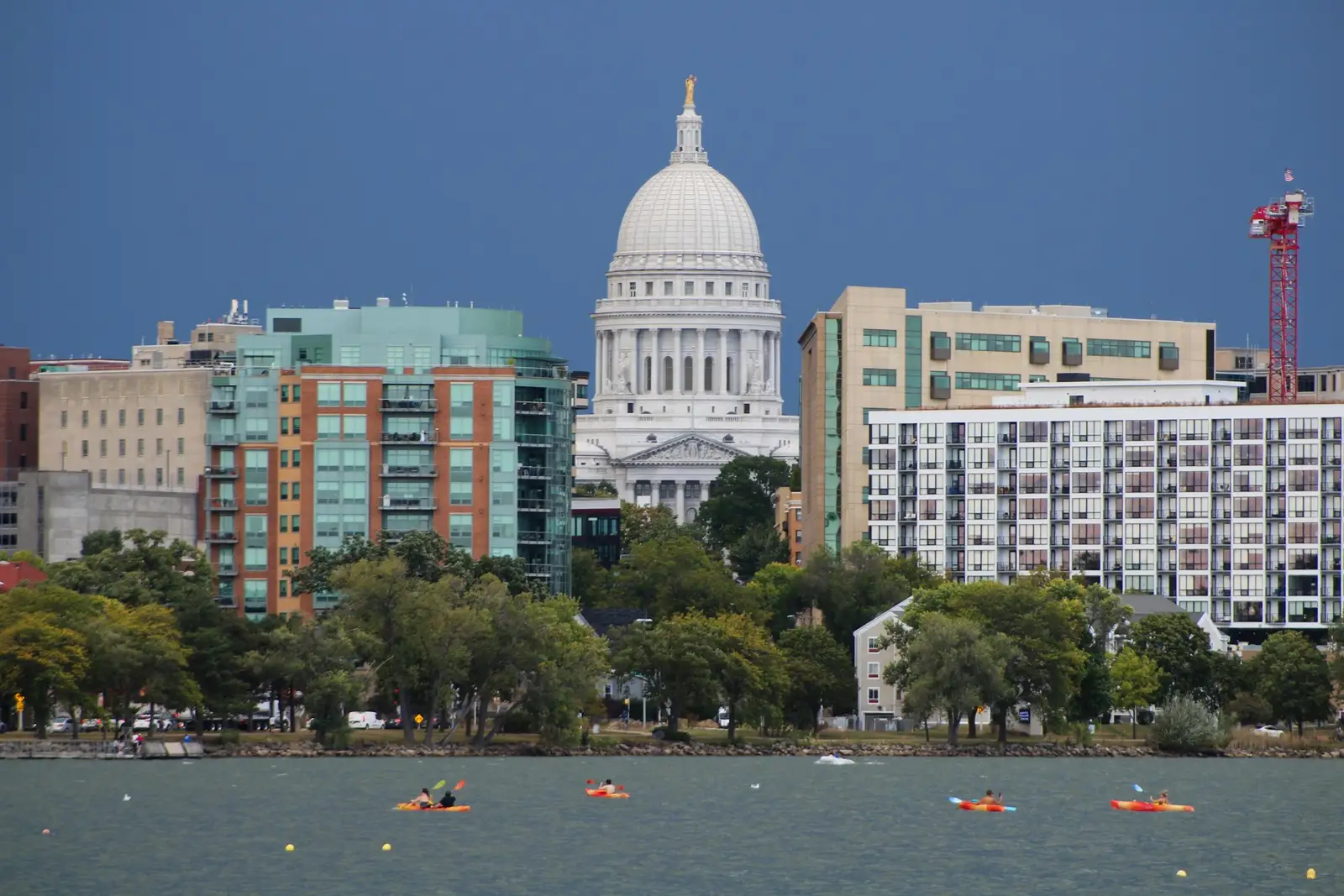
A lake city that runs on wells
Lake Mendota and Lake Monona frame downtown, but Madison Water Utility does not treat surface water at all. It runs a network of roughly twenty deep wells scattered across the city, each with its own pump house, drawing from the sandstone aquifer hundreds of feet below. Water is disinfected and fluoridated at each well and pumped into the distribution system and reservoirs. Which well feeds your block can change with demand, so water quality varies a bit from neighborhood to neighborhood.
That aquifer water picks up calcium and magnesium from dolomite and sandstone, and Madison water is very hard, frequently around 17 grains per gallon or more. In a gas tank it settles into a thick, chalky bed that insulates the bottom from the burner and makes the tank crack and pop as it heats. Electric tanks fare worse, because scale builds on the lower element until it overheats. A tankless heater on unsoftened Madison water can lose flow within a couple of years if it is never descaled.
Some wells carry extra baggage. Iron and manganese show up in several, and the utility has added filtration at some sites after complaints of brown or black water. PFAS chemicals tied to firefighting foam near Truax Field led Madison to take Well 15 on the east side offline. None of that changes how a heater works, but discolored water that suddenly appears from only the hot tap is often manganese or iron sediment settling in the tank, and a flush usually clears it.
Isthmus flats, near-west bungalows and Hill Farms ranches
The isthmus and east side hold some of Madison's oldest houses. Along Williamson Street, in Marquette, Schenk-Atwood and Tenney-Lapham, you find late Victorian homes, workers' cottages and two-flats, many now split into rentals. Their basements are low, with fieldstone or limestone walls and narrow stairs, and a heater for each unit often lines one wall.
On the near west side, Vilas, Dudgeon-Monroe, Regent and University Heights are packed with 1910s to 1930s bungalows, Prairie-influenced homes and period revivals, many rented to students and staff from UW. Further west, Hill Farms, Westmorland, Sunset Village and Nakoma moved to ranches and Cape Cods after the war. Newer neighborhoods on the far west and southeast sides, like those around Elver Park or toward Cottage Grove Road, tend to have finished lower levels, where the tank shares a small mechanical closet with the softener and furnace.
Repairs Madison plumbers book most
- Popping and crackling tanks from a deep mineral bed laid down by unsoftened well water.
- Burned lower elements in electric tanks in near-west student rentals.
- Brown or black water from the hot side where manganese sediment has collected in the tank.
- Seized drain valves packed with scale on heaters nobody has flushed in a decade.
- Over-softened water eating through anodes in east side homes with a softener set too high.
- Cold-snap pilot outages in drafty isthmus two-flats when northwest winds hit old chimneys.
Water heater prices in Madison
| Job | Typical Madison range | Notes |
|---|---|---|
| Thermocouple, igniter or pilot | $150–$300 | |
| Gas control valve | $350–$625 | |
| Lower element and thermostat | $180–$380 | Scale damage is the usual cause |
| Full flush or tankless descaling | $125–$300 | Heavy scale may take longer |
| Anode rod replacement | $150–$325 | Aluminum or powered anode options |
| 40–50 gallon gas tank replaced | $1,450–$3,000 | City permit normally included |
| Tankless gas unit installed | $3,300–$6,200 | Softener strongly advised |
Dane County labor is a little higher than in much of Wisconsin. A tight isthmus basement, a chimney that needs a liner, or a weekend call during a February deep freeze will push a Madison quote higher, while an open utility room in a newer west-side home keeps it closer to the low figure.
Permits and plumber licensing in Madison
Wisconsin's Department of Safety and Professional Services, DSPS, licenses master and journeyman plumbers across the state, with a public credential search online. Within city limits, the City of Madison Building Inspection Division signs off on tank replacements through its own permit, and an inspector visits to look over gas fittings, the flue and where the relief line drains. Fitchburg, Middleton, Monona and the other neighboring communities run their own inspection offices.
Check that the plumber's DSPS credential is active before booking, and ask whether the Madison Building Inspection fee is listed as its own line on the estimate.
Softeners, salt and the Yahara lakes
A water softener is the biggest favor a Madison homeowner can do for a heater, and a large share of homes here already have one. Softened water stops most scale, keeps tankless heat exchangers clear and helps electric elements last. There is a catch: chloride from softener regeneration flows through the sewer and wastewater plant into the Yahara lakes, where it does not break down. Local programs such as Wisconsin Salt Wise have pushed residents to set softeners to the actual hardness of their water and use high-efficiency models.
Water softened all the way to zero also chews through a standard magnesium anode. Many Madison plumbers recommend setting the softener to leave a few grains of hardness and checking the anode more often, or switching to an aluminum or powered rod.
Keeping a heater healthy on Madison well water
Without a softener, a yearly flush is the main defense. Draining a few gallons each season helps too, but the scale here can harden into chunks that will not pass through a drain valve, so a plumber may need to remove the valve or use a wand to break it up. Tankless owners should descale annually; a unit that already shows flow faults may need a technician visit.
Groundwater means Madison heaters do not face the near-freezing winter inlet temperatures Milwaukee's lake water brings. Inlet water stays in the 40s or low 50s, so sizing is closer to normal. Still, subzero snaps raise demand, and a shared heater in an old two-flat will struggle when every tenant showers before a morning class.
MGE and choosing a new heater
Madison Gas and Electric, MGE, delivers gas and power to most Madison addresses, and it has promoted efficiency programs and rebates at times, including for heat pump water heaters. A heat pump tank suits a roomy unfinished basement where its cooling effect is not a problem. In a tiny isthmus cellar a high-efficiency gas or power-vent tank is often simpler.
Under about eight years, replacing a failed gas control or thermocouple usually pays off on the isthmus. Because hard water shortens tank life, an unsoftened Madison tank past ten years that rumbles, weeps or rusts at the base is best replaced before it fails on a cold night.
Around Madison
Middleton, Fitchburg, Verona, Sun Prairie and Monona run their own well systems and building inspection offices, and their water is similarly hard. Shorewood Hills and Maple Bluff are small villages surrounded by Madison with their own permit rules. Waunakee, McFarland and Stoughton also pump hard groundwater, and rural homes across Dane County rely on private wells that often carry iron as well.
Water heater questions from Madison
Does Madison use water from Lake Mendota or Lake Monona?
No. Madison Water Utility relies only on deep sandstone wells. The lakes are not a drinking water source.
Just how hard is the water on the isthmus?
Very hard, frequently 17 grains per gallon or more. That is among the harder municipal supplies in Wisconsin.
Why is my hot water brown but the cold water looks fine?
Manganese or iron sediment from some city wells settles in the tank. Flushing the heater usually clears it.
What office issues water heater permits in Madison?
The City of Madison Building Inspection Division. Plumbers themselves are licensed by Wisconsin DSPS.
How should I set my softener so it protects the heater without wasting salt?
Set it to your well's actual hardness and leave a little hardness in the water. That saves salt for the lakes and protects the anode.
Does MGE help pay for a heat pump water heater?
MGE has offered rebates and programs at times. Check its current offers before you buy.
Which Madison well serves my house?
Madison Water Utility publishes well information and water quality reports online, and service areas can shift with demand.