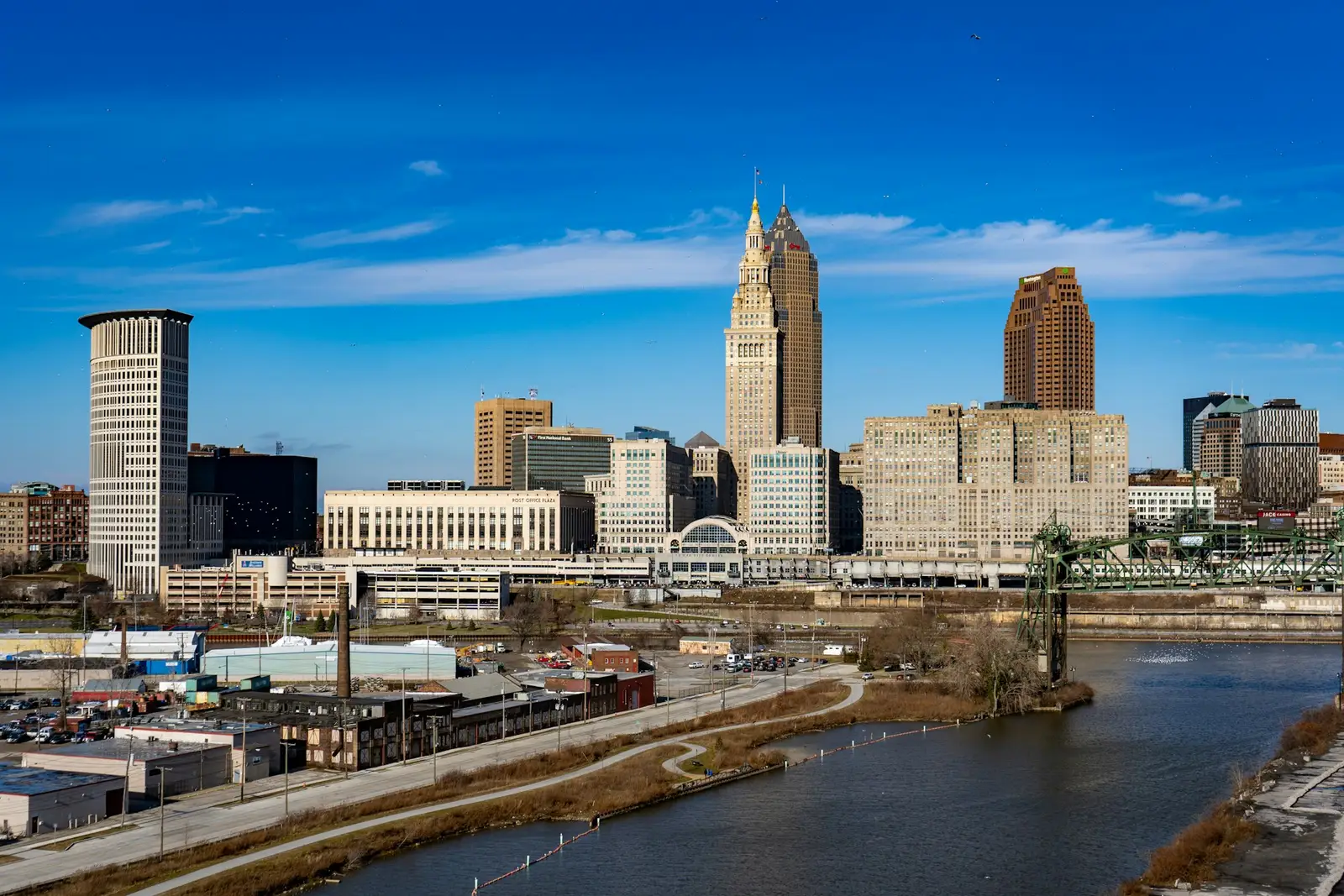
Lake Erie water from four plants
Cleveland Water is one of the largest water systems in the country, serving the city and most of Cuyahoga County plus parts of neighboring counties. It draws from Lake Erie through intake cribs several miles offshore and treats the water at four plants. The Baldwin plant sits near University Circle and dates to the 1920s. The Crown plant is on the west side, the Morgan plant is in the Flats near the Cuyahoga, and the Nottingham plant serves the east side near Collinwood.
Finished water from all four plants is moderately hard, roughly 7 or 8 grains in each gallon. That leaves a thin bed of grit on the tank floor in Ohio City and Old Brooklyn basements over time and will crust the heat exchanger of a tankless unit that never gets descaled, but it is far gentler than well water in rural Ohio. Because the lake is large and stable, hardness does not swing much through the year. What does swing is temperature.
Lake-effect winters and cold inlet water
Once Lake Erie cools in late fall, water entering Cleveland homes falls into the mid to upper 30s and stays there until spring. The same cold air crossing the open lake drops lake-effect snow on the east side and the Heights, and those storms are when hot water calls spike. A tank that keeps up fine in July has to lift every gallon by 85 degrees or more in February, and families notice the shorter showers first.
Snowbelt cold also reaches pipes. Supply lines along exterior basement walls, plumbing in porches enclosed decades ago, and kitchens added onto the back of older houses can freeze during a long arctic stretch. A heater that suddenly gets no cold water from a frozen line will overheat and trip its high limit, or, on electric models, burn out an element. Keeping basement windows sealed and the furnace running during cold snaps protects both pipes and the heater.
Doubles and century homes with basements
Cleveland's signature house is the double, sometimes called an up-and-down: a two-family frame house with one flat stacked on the other, common in Slavic Village, Tremont, Ohio City, Detroit-Shoreway, Clark-Fulton and Collinwood. Typically each flat has its own heater, and the pair stand side by side downstairs, sometimes tied into one chimney. Some older doubles still run one heater for both floors, which leaves the upstairs tenant waiting on long pipe runs.
Single-family century homes fill Old Brooklyn, Kamm's Corners, Buckeye-Shaker and Glenville, and the inner suburbs of Lakewood, Cleveland Heights and Shaker Heights have even more. Nearly all have full basements with the heater beside the furnace, a floor drain nearby, and gas piping that has been extended and patched over a century. Basement flooding after heavy summer storms is a familiar problem in low-lying parts of the east and west sides.
The problems plumbers see most in Cleveland
- Short hot water during lake-effect season when 36°F lake water meets a 40-gallon tank.
- Two heaters crowding one old flue in Slavic Village and Tremont doubles.
- Stranded chimney venting after a furnace upgrade to sidewall PVC.
- Leaking tank bases in damp basements with poor floor drains.
- Storm-flooded gas controls after summer downpours overwhelm the sewers.
- Corroded gas piping and unions in century homes during heater swaps.
Typical water heater prices in Cleveland
| Job | Typical Cleveland range | Notes |
|---|---|---|
| Thermocouple or pilot assembly | $150–$300 | |
| Gas control valve | $350–$625 | |
| Electric element or thermostat | $175–$375 | |
| Flush and sediment removal | $100–$250 | |
| Chimney liner or vent correction | $275–$950 | Common in doubles |
| 40–50 gallon gas tank replacement | $1,400–$3,000 | Permit usually included |
| Tankless installation | $3,200–$6,000 | Gas line upsizing often extra |
Cleveland labor is moderate by national standards. Replacing both heaters in a double at once usually costs less per unit than two separate visits, while narrow basement stairs, rotted gas piping and chimney liners push individual jobs toward the high end.
Permits and licensing in Cleveland
For any Cleveland address, the City of Cleveland Department of Building and Housing issues the water heater permit, and the work is inspected for venting, gas connections, the relief valve discharge and combustion air. Cleveland also licenses plumbers itself, so the person doing the work should hold a Cleveland plumbing license in addition to any state credentials.
At the state level, the Ohio Construction Industry Licensing Board, or OCILB, licenses plumbing and hydronics contractors, and you can check a contractor's OCILB status online. Each suburb has its own building department with its own permit process, so a plumber who works in Parma or Euclid may need a separate registration there. Before signing a quote, confirm the contractor will pull the Building and Housing permit for a Cleveland address.
Venting in doubles and old chimneys
Venting is where Cleveland jobs get complicated. A typical double was built with one brick chimney serving a coal furnace or two, and over the years it was asked to carry a pair of gas furnaces and a pair of water heaters. When one or both furnaces are upgraded to high-efficiency models that vent out the side, the water heaters are left in a flue far too large for them. The exhaust cools, condensation eats the mortar, and spillage at the draft hood becomes likely on cold mornings.
The usual fixes are a properly sized liner, or power-vent water heaters that exit through the rim joist. In a double, coordinating both units at the same time often saves money and gets one inspection instead of two. A carbon monoxide alarm on each floor is a smart addition in any Cleveland home with gas appliances in the basement.
Repair or replace in Cleveland
On moderately hard Lake Erie water, a gas tank that gets an occasional flush commonly lasts 10 to 13 years. Younger than that, a new thermocouple, relief valve, element or gas valve is generally money well spent. Older than that, or once the tank weeps at a seam, a planned swap beats an emergency one, especially in a rented double where a leak soaks the lower flat's storage.
Fall is the best time to replace an aging heater in Cleveland, before lake-effect season raises demand and fills plumbers' schedules. Dominion Energy Ohio, now operating as Enbridge Gas Ohio, supplies most homes with natural gas, while electricity comes from FirstEnergy's Illuminating Company or, in parts of the city, Cleveland Public Power. Both gas and electric providers have offered efficiency programs at times, so ask about current offers before choosing a model.
Around Cleveland
Cleveland Water serves most surrounding suburbs, but permits stay local. Lakewood, Parma, Euclid and Cleveland Heights each run their own building departments and inspections. Shaker Heights has strict standards for its older homes, and Westlake and Strongsville have newer housing with heaters in utility rooms and garages. Communities in Lake and Summit counties may use other water suppliers, so the water and the permit office can both change a few miles out.
Water heater questions from Cleveland
Who issues water heater permits in Cleveland?
The City of Cleveland Department of Building and Housing issues them for addresses inside the city. Suburbs such as Lakewood and Parma have their own building departments.
How hard is Cleveland water?
Lake Erie water from Cleveland's four plants lands in the moderate range, near 7 or 8 grains, so sediment builds gradually rather than quickly.
Does Cleveland license its own plumbers?
Yes. The city licenses plumbers working within its limits, and Ohio's OCILB separately licenses plumbing contractors statewide.
Why do both heaters in my double back up smoke near the vent?
Two heaters in an oversized or partly blocked chimney often draft poorly, especially after a furnace upgrade. Have the flue inspected and sized before relighting.
Why is my shower colder during lake-effect storms?
Inlet water falls into the 30s in winter, so the tank recovers slowly. If the heater checks out, a bigger or faster-recovering model is the long-term fix.
Who supplies gas for water heaters in Cleveland?
Most homes get natural gas from Enbridge Gas Ohio, the company formerly known as Dominion Energy Ohio.
My Cleveland basement took on storm water around the heater. Now what?
Shut off gas and power if you can do it safely, and do not relight until a plumber inspects the controls. Submerged gas valves are normally replaced.