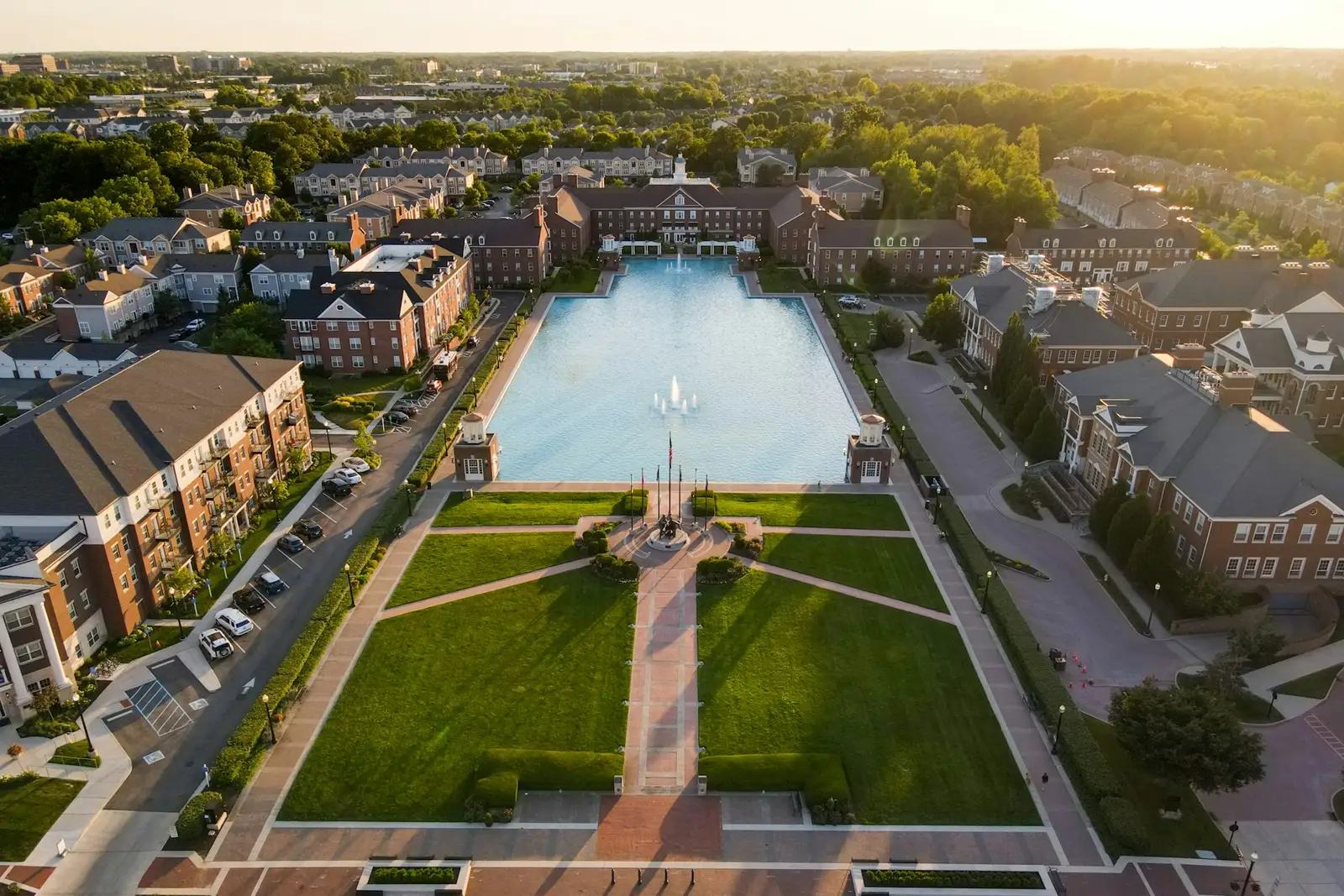
Carmel's own wells and softening plants
Unlike Fishers and much of Hamilton County, which buy water from Citizens Energy Group, most of Carmel is served by Carmel Utilities, a city-owned department. Its wells tap the sand and gravel aquifer along the White River valley on the city's east side, and the raw water is pumped to city treatment plants where lime is added to precipitate calcium and magnesium before filtration.
The practical effect is water that reaches Carmel homes much softer than it was in the ground. It is not as soft as New England reservoir water, and a test kit will still register measurable hardness, but tanks fill with sediment far more slowly than they do a few miles east. Many Carmel owners skip a home softener entirely, and plenty of others keep one anyway for the last bit of hardness and for spot-free glass.
Because the supply is groundwater, the temperature coming in barely moves through the year. Inlet water usually holds somewhere around 52 to 55 degrees through a Carmel February, which is warmer than a reservoir-fed city gets in winter. Heaters in Carmel recover a little faster in cold months than they would on surface water.
A few pockets at the city's edges, particularly in areas annexed from Clay Township, may still be on a different provider. If the bill does not say Carmel Utilities, ask your plumber to assume harder water when planning maintenance.
Big houses, two heaters and finished basements
Carmel has a lot of square footage. Subdivisions such as Brookshire, Woodland Springs and Johnson Addition date from the 1960s through the 1980s, with ranches and two-story homes, many over basements. Farther west, in Clay Township neighborhoods like Village of WestClay, Laurelwood and the estates off Spring Mill Road, homes of five thousand square feet or more are common.
Larger homes here are frequently built with two water heaters, either two 50-gallon tanks piped in parallel in one mechanical room or separate heaters serving opposite wings of the house. A recirculation pump on the hot line is common so a primary suite at the far end does not wait a minute for warm water. When one of a pair fails, owners often do not notice right away; the other heater carries the load until a large bath or houseful of guests reveals the shortfall.
Basements in Carmel are often finished with a theater room, a bar or a guest suite, leaving the heater tucked into a small unfinished closet. Tight closets limit how a new unit can be vented and how much clearance a plumber has to work.
Old Town, the Arts & Design District and newer townhomes
Around Main Street and the Arts & Design District, the original town of Carmel still has older frame houses, some with crawlspaces and heaters in a back porch closet or kitchen alcove. Many have been extensively remodeled, and remodels sometimes leave a heater in an awkward spot with a long, cold run to the newest bathroom.
The redevelopment around Carmel City Center, the Center for the Performing Arts and the Midtown area has added hundreds of townhomes and condominiums. Those units often carry compact electric heaters or tankless gas units in small first-floor closets, and replacing them means working within the building's venting layout and the association's rules.
The problems plumbers see most in Carmel
- One of two parallel tanks failing quietly until a holiday crowd runs the household short.
- Recirculation pumps and check valves wearing out, so hot water takes forever to reach the far bathroom.
- Closet-bound power-vent heaters whose blower motors or pressure switches give out.
- Tankless units starved for gas after a gas range, fire pit or pool heater joins the same line.
- Leaks above finished ceilings where a basement heater drips onto drywall and carpet before anyone sees it.
- Thermal expansion problems on homes with pressure-reducing valves but no expansion tank.
Typical water heater prices in Carmel
| Job | Typical Carmel range | Notes |
|---|---|---|
| Igniter, flame sensor or thermocouple | $175–$350 | |
| Power-vent blower or pressure switch | $275–$650 | Common in closet installs |
| Recirculation pump replacement | $350–$800 | Includes check valve |
| Expansion tank installation | $200–$425 | |
| Single 50 gallon gas tank replacement | $1,600–$3,300 | Permit included |
| Pair of tanks or 75–100 gallon unit | $3,200–$6,500 | Depends on venting |
| Whole-house tankless installation | $3,800–$7,000 | Gas line sizing drives cost |
Carmel jobs tend to price a bit above the Indianapolis average, mostly because of the equipment involved. Replacing two heaters at once, working in a finished-basement closet, or upsizing a gas line for a high-output tankless unit takes more time and material than a standard swap.
Permits through Carmel's Department of Community Services
Building and plumbing permits in Carmel go through the city's Department of Community Services, whose Building and Code Services staff handle inspections. A water heater replacement normally needs a permit, and Carmel's inspector reviews the flue or vent pipe, the gas hookup, the relief discharge and expansion protection. Unincorporated addresses, Westfield to the north and Indianapolis to the south use their own offices.
The Indiana Plumbing Commission licenses the plumbers who can pull those permits. A legitimate Carmel contractor will have a state plumbing contractor license and should be comfortable showing it on the first visit.
Duke Energy provides electricity across most of Carmel, and natural gas is delivered by CenterPoint Energy in the territory once known as Vectren North. Both utilities have run rebate programs on efficient water heaters at times, which can help on a heat pump unit for a large home.
Choosing between two tanks and one tankless unit
When a Carmel family replaces a pair of aging tanks, the question is almost always whether to stay with two tanks or switch to one or two tankless units. Two tanks are simple and forgiving, and a failure in one still leaves hot water. Tankless saves floor space and never runs out, but a large home with multiple showers may need two units cascaded together, and the gas service has to support them.
Carmel's softened city water is a point in favor of tankless here, since heat exchangers scale up more slowly than they would in Fishers or on a private well. They still benefit from a yearly check of the inlet filter and a descale every year or two, and service valves on the unit make that job quick.
Spotting leaks before they reach the drywall
A leaking heater in a finished Carmel basement can soak carpet, baseboard and drywall long before anyone walks into the mechanical closet. A pan with a drain line under each tank, a water sensor on the floor, or an automatic shutoff valve that closes the cold supply when it detects water are inexpensive insurance in a basement full of finishes.
Signs worth calling about include rust-colored water from one faucet group, a damp ring at the base of a tank, a hissing relief valve, or a sudden rise in the gas or electric bill as a failing heater runs longer. Standing water on the closet floor means it is time to shut the cold supply above the heater and kill the gas or breaker, then call.
Repair or replace in Carmel
Because Carmel's water is kind to tanks, heaters here often reach twelve years or more. Burner parts, power-vent blowers and relief valves are worth replacing on tanks under ten. If one of a matched pair begins leaking at eleven or twelve, replacing both at once usually saves a second service call and keeps the system balanced. What a Carmel swap typically involves is covered in our page on swapping out a heater, from haul-away to permit.
Around Carmel
Westfield to the north has grown quickly with large new subdivisions and its own permit office. Zionsville, across the Boone County line to the west, has town water in its core and wells on many outlying lots. Fishers to the east and the Nora area of Indianapolis to the south both drink harder water from Citizens, so heaters there scale up faster than in Carmel.
Water heater questions from Carmel
Is Carmel water hard?
Less than most of central Indiana. Carmel Utilities softens its well water with lime at its treatment plants, though some hardness remains.
Do I still need a home softener in Carmel?
Many homes do fine without one. A softener can still help with spotting and the remaining hardness, and it is worth having on a tankless unit.
My house has two water heaters. Should I replace both at once?
If they are the same age and one is leaking, doing both together is usually cheaper than two separate visits a year apart.
Why is my water warmer in winter than my friend's in Indianapolis?
Carmel's supply comes from wells, so it enters the house in the 50s all year, while reservoir water in Indianapolis drops near 40°F.
Who issues water heater permits in Carmel?
The Department of Community Services, through its building and code services staff, which also schedules the inspection.
Why does the hot water take so long to reach our primary bath?
In large homes the pipe run is long. A recirculation pump, or fixing a failed one, usually solves the wait.
Can my gas line handle a tankless heater?
Not always. Many Carmel homes added gas appliances over the years, so a plumber should run a load calculation before installing.